Dreamspell Count (DSC)
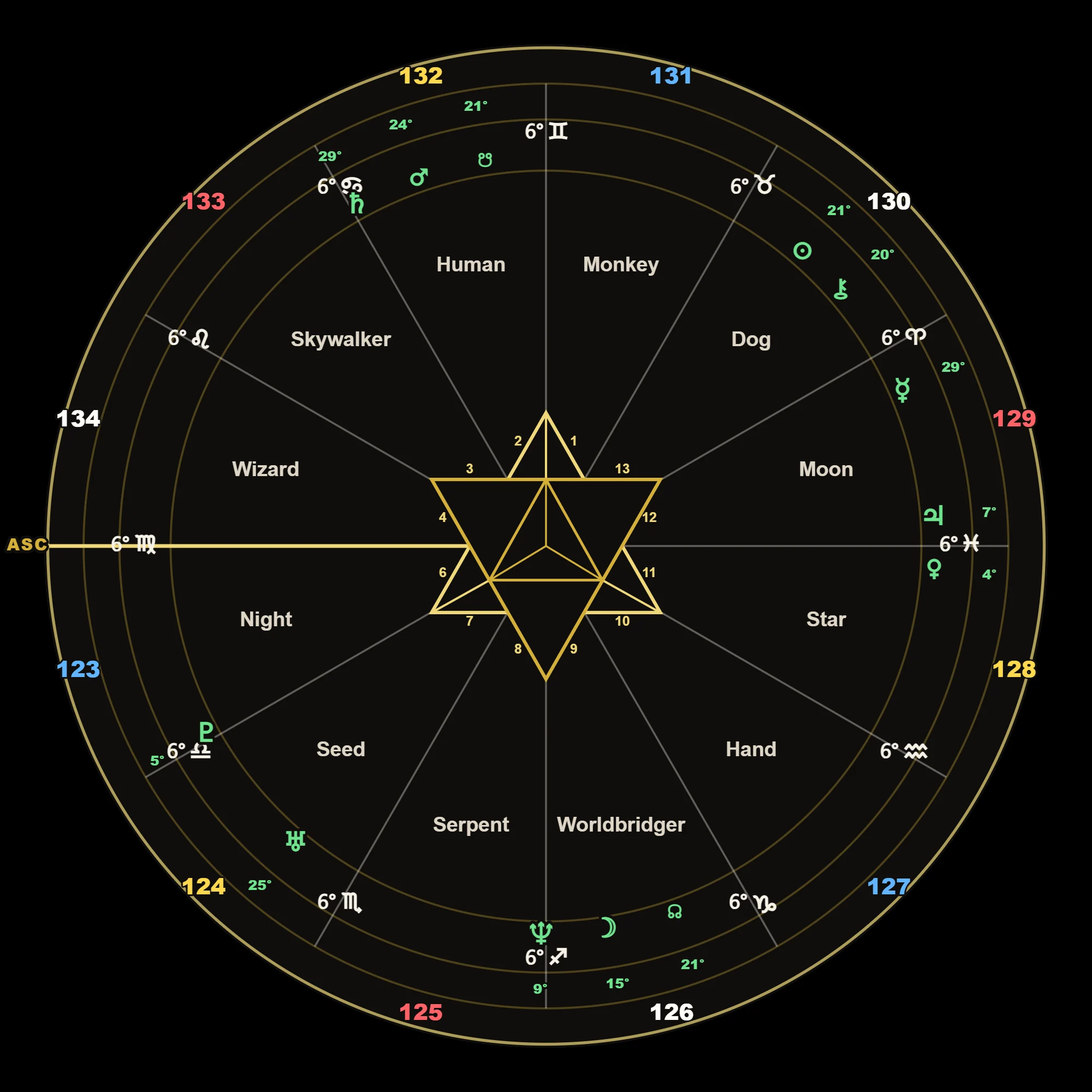
11 APR 1974 · Kin 123 · Tone 6 · Solar Seal Night/Akbal
Traditional astrology builds a chart based on the rotation of the Earth. The birth time and place determine what part of the sky is rising on the horizon. This is what astrologers use to determine the Rising Sign and Degree of the Ascendent. Zuvuya doesn’t use the Earth’s rotation. It builds from the mathematical sequence of 13/20.
The first layer of the chart is created by converting the birth day, month and year to the corresponding Kin number (1-260) Tone number (1-13) and Solar Seal (1-20). It can convert to either the Dreamspell Count or the Mayan Long Count, both counts are derived from the Mayan Tzolkin.
Both charts below use the same birthdate, 11 April 1974. At this first stage, only the Kin number, Tone and Solar Seal are placed on each chart; the remaining positions are left blank.
11 APR 1974 · Kin 123 · Tone 6 · Solar Seal Night/Akbal
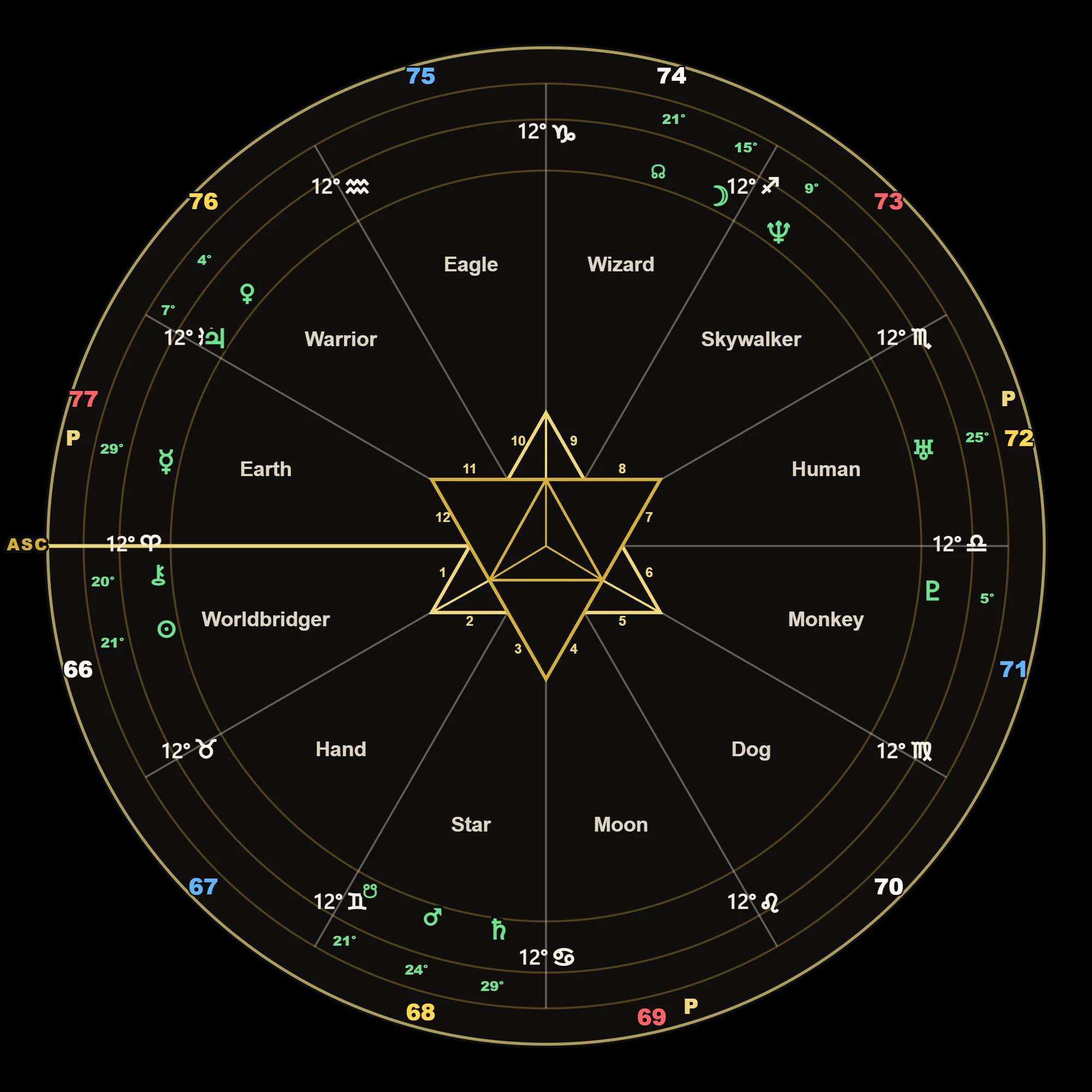
11 APR 1974 · Kin 66 · Tone 1 · Solar Seal White World Bridger/Cimi
The Kin # is used to ascertain the degree of the Ascendant.
The Tone # is used to ascertain the Astrological Rising Sign.
The next examples use the same birthdate and add the rising degree and sign after the Kin and Tone have been introduced.
Kin 123 · 1+2+3/6 · Tone 6 · 6° Virgo Rising · Night/Akbal
Kin 66 · 6+6/12 · Tone 1 · 12° Aries Rising · White World Bridger/Cimi
Tone 1-12 Follow the Astrological sequence Aries-Pisces
Tone 13 becomes 4/Cancer
The Ascendant is never more than 13 Degrees
The ZHS uses Equal Houses
4/11/1974 · 10:00 · Porto, Portugal
Kin# 123
Kin# 66
This table shows where each planet falls in your chart. Position gives its zodiac sign and degree (℞ means retrograde). The three house columns show the same planet placed in three different house systems: the conventional Equal House chart, the Zuvuya Dreamspell Count (DSC) chart and the Zuvuya Mayan Long Count (MLC) chart. The planet never changes; what changes is the area of life it is read in. Comparing the columns shows which themes stay stable across systems and which shift.
| Body | Position | Astrology House | DSC House | MLC House |
|---|---|---|---|---|
| ☉ Sun | 21°05′49″ Aries | 11 | 8 | 1 |
| ☽ Moon | 15°21′32″ Sagittarius | 6 | 4 | 9 |
| ☿ Mercury | 29°34′44″ Pisces | 10 | 7 | 12 |
| ♀ Venus | 4°50′17″ Pisces | 9 | 6 | 11 |
| ♂ Mars | 24°40′52″ Gemini | 1 | 10 | 3 |
| ♃ Jupiter | 7°31′48″ Pisces | 9 | 7 | 11 |
| ♄ Saturn | 29°24′25″ Gemini | 1 | 10 | 3 |
| ♅ Uranus | 25°57′22″ Libra ℞ | 5 | 2 | 7 |
| ♆ Neptune | 9°22′23″ Sagittarius ℞ | 6 | 4 | 8 |
| ♇ Pluto | 5°02′28″ Libra ℞ | 4 | 1 | 6 |
| ⚷ Chiron | 20°23′49″ Aries | 11 | 8 | 1 |
| ☊ True North Node | 21°06′04″ Sagittarius ℞ | 7 | 4 | 9 |
| ☋ True South Node | 21°06′04″ Gemini | 1 | 10 | 3 |
Aspects are the angles between two bodies, and they show how those energies interact. This list uses the Zuvuya House System (ZHS) aspect set: 0°, 52°, 60°, 72°, 90°, 120°, 144° and 180°. The Orb is how far the angle is from being exact, with a maximum allowed of 3°, so the closer the aspect is to exact, the more precise its alignment. Aspects are listed rather than drawn on the wheel to keep the chart easy to read.
| Body 1 | Aspect | Body 2 | Orb |
|---|---|---|---|
| True North Node | Opposition | True South Node | 0° 00′ |
| Sun | Trine | True North Node | 0° 00′ |
| Sun | Sextile | True South Node | 0° 00′ |
| Mercury | Square | Saturn | 0° 10′ |
| Sun | Conjunction | Chiron | 0° 42′ |
| Chiron | Sextile | True South Node | 0° 42′ |
| Chiron | Trine | True North Node | 0° 42′ |
| Mars | Trine | Uranus | 1° 16′ |
| Moon | 72° Aspect | Pluto | 1° 41′ |
| Venus | 72° Aspect | True North Node | 1° 44′ |
| Jupiter | Square | Neptune | 1° 51′ |
| Moon | 52° Aspect | Uranus | 2° 36′ |
| Venus | Conjunction | Jupiter | 2° 42′ |
| Saturn | 72° Aspect | Chiron | 2° 59′ |